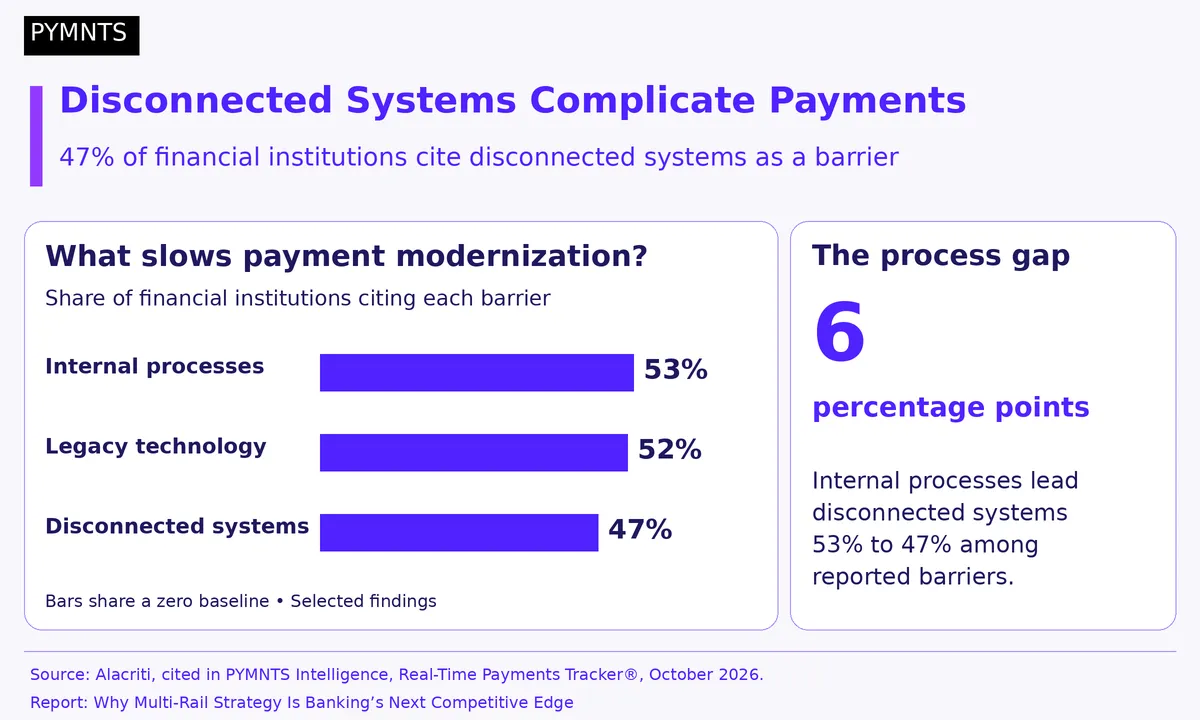
PYMNTS cites Alacriti research: 47% of financial institutions call disconnected systems the top barrier to payment experience, and 35% plan centralized payment hubs within 12-18 months. The numbers point to a shift already underway — payment orchestration spreading from e-commerce acquiring to the banking side.
What is the multi-rail dilemma?
Banks hold cards, ACH, instant payments and wires — each rail with its own cost, speed and availability. Customers want to pay and don't care which rail is used; internally, each rail is a separate system with separate risk and reconciliation. The cost of disconnection: agents cross-system status checks, no global pricing optimization, slow new-rail launches. PYMNTS compares orchestration to a navigation app — the customer states the destination, and the bank picks the route by amount, urgency and cost.
Where does the orchestration competition go?
My judgment: the 47% figure says market education on the banking side is complete; competition shifts from whether to orchestrate to whose orchestration is smarter. The 35% planning centralized hubs are essentially lifting payment decisions from rail-by-rail silos to a single decision layer. For infrastructure vendors, the opportunity is clear: whoever makes multi-rail integration a low-cost hub product captures the bank modernization budget. For bank product managers, the roadmap priority should be reordered — fix the decision layer first, then add rails, or new rails will only deepen the fragmentation.
The intersection with agentic commerce
A notable intersection: agentic commerce payments for enterprises will also traverse bank multi-rails. When an AI agent initiates payment on behalf of a company, the routing decision is either made by the agent (uncontrolled) or by the bank's orchestration layer (governable). Orchestration is thus not just a cost tool but the governance entry point of the agentic era — plausibly the deeper motive behind banks rushing to build hubs.
Further Reading
- Today's daily: AI wallets in India, tokenized deposits in Hong Kong, synchronized settlement in London — the deep-analysis companion to today's news
- Agentic commerce B2B payments: who defines AI payment authority — background on the authorization-layer competition
- Compressing settlement from T+3 to T+0: capital pools and FX exposure — the classic tradeoff between settlement speed and FX cost
This article is rewritten from PYMNTS. Original copyright belongs to the author, reproduced here for reference and learning.


