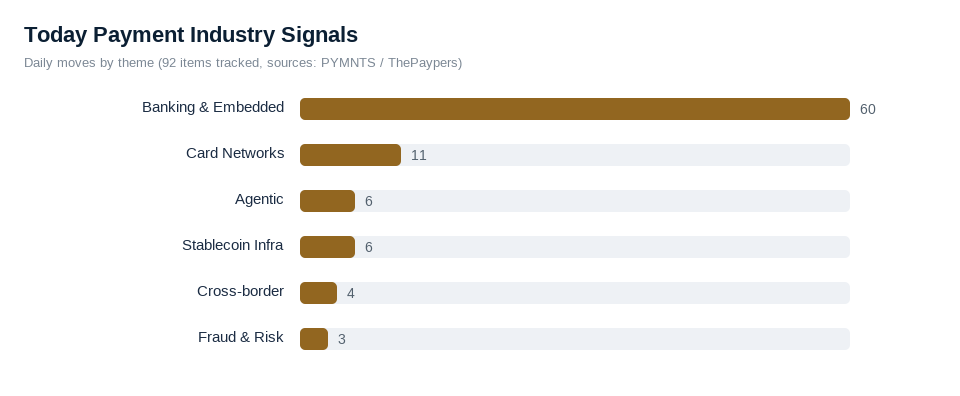
Look at today's signal distribution first. I tracked 92 payment-related moves across PYMNTS and ThePaypers today. Banking and embedded finance takes 60 — too broad a bucket to mean much. The real information lives in the layers: agentic 6, stablecoins 6, cross-border settlement 4, fraud & risk 3, plus card networks at 11. Today's international payments mainline is the automation of accounts and settlement.
India gets its first wallet designed for agents — what problem does it solve?
Cashfree launched Cashfree Wallet in India, letting AI agents complete payments autonomously. This is not another wallet app — it is designed for the last mile of agent payments.

Start with the pain point it targets. In agentic commerce, AI can already search products, compare prices, and fill carts, but stalls at payment: either push a QR code or payment link back to the user (task interrupted), or hand card details to the agent (security risk). Cashfree's own data: AI agent traffic on its checkout grew 16-fold this financial year, and 100+ personal agents and bot builders have already integrated the wallet.
Cashfree Wallet's answer is upfront consent: before the task, the user sets a budget and rules — max spend, max number of payments, permission validity. Every payment triggers a real-time alert, and access can be revoked anytime. The agent never sees the user's card, UPI, or bank account details.
My judgment: the significance is not the India market itself but the product pattern it validates — agent payment authorization equals budget plus rules plus revocability — structurally identical to Mastercard's AP4M on the enterprise side, except Cashfree does the consumer-side lightweight version. The trust problem of agentic commerce is being split into two layers: networks handle credentials (Visa/Mastercard), application layer handles experience (Cashfree). Payment product teams should treat "task-level authorization" as a standalone product module rather than waiting for card network standards.
What are Swift and the HKMA connecting? The tokenized deposit settlement layer
Swift and the Hong Kong Monetary Authority are connecting Swift's ledger with the settlement layer of Project Ensemble, with Bank of China (Hong Kong), Standard Chartered (Hong Kong), and HSBC (Hong Kong) participating. The goal: multi-currency tokenized deposits (tokenizing bank deposits for direct use in cross-border payments) to run cross-border payment mechanisms, using Swift's global network to bridge international and local payment interoperability.
The backdrop is the Ensemble sandbox — HKMA has explored CBDC interoperability since 2023. The extension pushes tokenized deposits to center stage. Why it matters: tokenized deposits require no new asset issuance (not stablecoins, not CBDC) — existing bank deposits put on-chain — the shortest compliance path and the highest bank acceptance. Swift's global network plus Hong Kong's banking cluster gives "tokenized deposits cross-border" a real multilateral testbed.
My judgment: the tokenization route in cross-border payments is diverging — stablecoins take the "new asset" route, tokenized deposits take the "existing assets on-chain" route. The latter is far less disruptive to the banking system and faces far less resistance. Teams building cross-border payment architecture should evaluate tokenized deposits as a standalone technical option, not lump it into a "crypto" bucket.
What is the Bank of England's synchronized settlement? Why watch it?
The Bank of England, with MAS and the Bank of Thailand, completed Project Meridian FX APAC: synchronized settlement — coordinating central bank money movements — connecting three central bank currency environments for cross-border FX settlement. The BoE plans a live synchronization interface in 2028.
Synchronized settlement solves Herstatt risk — the settlement risk from time-zone mismatch, where the gap between the two legs is the exposure. Synchronization makes "pay" and "receive" complete in the same instant, turning cross-border FX settlement from "T+0/T+2 trust" into "atomic certainty."
My judgment: this is the most hardcore wholesale cross-border payment infrastructure innovation, more important than any consumer-side cross-border news. The BoE's 2028 timeline means synchronization moves from papers to production within two years. Teams in corporate treasury and cross-border settlement should track this standard's evolution starting now.
Weak signal: 47% admit disconnected systems; orchestration rises
PYMNTS cites Alacriti research: 47% of financial institutions call "disconnected systems" the top barrier to payment experience, and 35% plan centralized payment hubs within 12-18 months. This signal and today's tokenization/synchronization are two sides of one coin: the rails are being swapped (tokenized deposits, synchronized settlement) while the scheduling layer is being swapped too (payment orchestration).
Payment orchestration — dynamically selecting payment routes — is spreading from e-commerce acquiring to banking: banks are adopting a "navigation app" logic for their own multi-rail (card, ACH, instant, wire) decisions. The 47% figure says market education is complete; competition shifts to "whose orchestration is smarter."
Connecting today's signals: the application layer does task-level authorization (Cashfree), the network layer does credentials (card networks, see yesterday's daily), the settlement layer does synchronization and tokenization (Swift/HKMA, BoE). Payment infrastructure automation is moving from the surface (agents placing orders) into the foundation (atomic settlement). The practitioner takeaway, unchanged: product direction is not "more rails" but "thicker layers" — with one addition today: settlement synchrony.
Further Reading
- Yesterday's daily: card networks grab authorization, QR interconnection, stablecoins in the funding layer — today's "network layer handles credentials" continued; read together
- $500M of certainty: SME cross-border banking becomes an API business — "certainty" extended to the settlement layer
- Finmo puts J.P. Morgan's network inside its product — what synchronized settlement means for treasury products
This report synthesizes and analyzes today's public reporting from PYMNTS and ThePaypers; views are my own.


