Look at today's signal distribution first. I tracked 90 payment-related moves across PYMNTS and ThePaypers today. Banking and embedded finance takes 57 of them — too broad a bucket to mean much. The real information lives in the layers: agentic payments, card networks, cross-border interconnection, stablecoins, payouts — one storyline each.
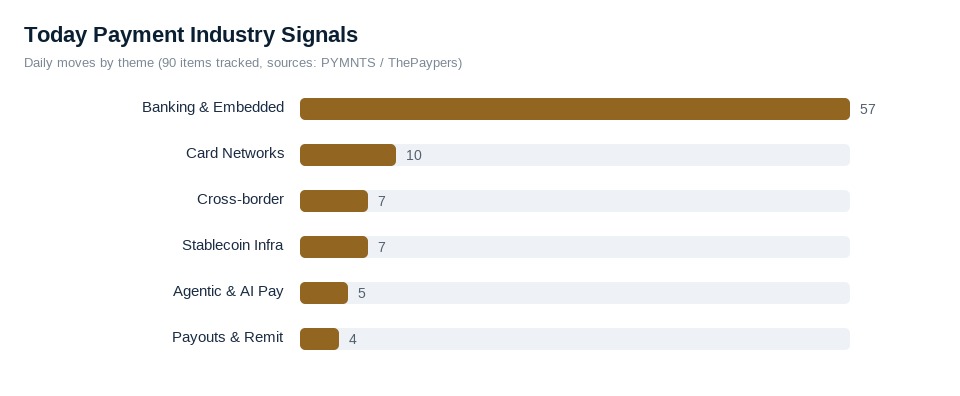
My read of the day comes down to one sentence: competition among payment networks is shifting from "whose network is bigger" to "who can stack authorization and funding capability on top of the network." Three things happened at once.
One: card networks productized authorization
Mastercard and Ant International finished two agent payment tests in APAC: a consumer AI agent buying a coffee on Verifiable Intent, and a Singapore AP4M pilot where enterprises issue credentials to AI agents, set spending limits and enforce them at the point of payment. Both tests share one core: authorization moves from an implicit state inside a session to a verifiable, auditable data structure.

My judgment: this move echoes the history of 3DS. 3DS consolidated authentication from a patchwork of merchant and issuer implementations into a network standard. Verifiable Intent and AP4M want to do the same for authorization — in agent commerce the first question of every transaction becomes "who authorized this machine," and card networks are grabbing the right to answer it. For payment product teams the signal is direct: agent credentials plus policy controls are becoming a layer of payment infrastructure. Issuers and acquirers will overlay it on existing authorization systems sooner or later — earlier means better positioning.
Two: card-QR interconnection goes live
Visa and Alipay+ launched cross-border QR payments in Asia Pacific: Samsung Wallet users in Singapore and Australia can pay with Visa credentials at Alipay+ merchants in Hong Kong and Malaysia; Google Wallet users from supported markets can do the same in Singapore. The mechanics run on Visa Pay, injecting card credentials into Alipay+'s QR acceptance network — 210-plus markets, 150 million merchants.

The structural significance is undersold by the headline. APAC is the most acceptance-fragmented market on earth: one logic for cards, another for QR, plus a pile of local schemes. Visa has turned card credentials into a payment credential injectable into any QR acceptance network — wallets integrate once for multi-market acceptance, merchants need zero changes to capture international spend. Practitioners in China will recognize the logic: UnionPay networked offline acceptance, NetsUnion consolidated third-party direct connections — same problem, fragmented acceptance. The difference: Visa is doing it cross-border, injecting card credentials into the QR world. QR acceptance networks are thereby repriced — no longer merely "how locals pay" but the landing container for global card credentials. Acquirers who still define themselves as "the QR acquirer of one country" may miss this consolidation round.
Three: stablecoins entered the funding layer
Visa is extending stablecoin prefunding to Asia Pacific with Singapore's dtcpay: clients can use stablecoins to fund cross-border payouts through Visa Direct, plugging into its network of 18 billion endpoints. The capability entered commercial production in the US with Inyo Global just last month.
Many read this as "Visa supports stablecoin payments." That is a misread. Recipients still receive fiat into bank accounts — stablecoins play the role of a liquidity tool, not a payment method. What it solves is the idle cost of nostro/vostro pre-positioned balances: turning "move fiat ahead of time" into "convert on demand, instantly" — 24/7, minutes, topped up as needed. Visa Direct's global head Vira Platonova framed it precisely: the long-term value of stablecoins lies in how effectively they connect with the financial systems businesses already use. Translation: the successful form of stablecoins is not replacing anyone's payment interface but embedding into existing funding chains as an efficiency tool. Of the three possible product positions (payment, settlement, funding layers), this is the one with the cleanest ROI.
Weak signals and continuity
One weak signal worth noting: LianLian's PayPal Payouts partnership extends its payout network to 96 countries with email-or-phone delivery. Payouts are the systematically underestimated track of cross-border payments — while everyone competes on collection fees, payouts still competes on coverage and success rates. Stack it on yesterday's 83% B2B embedded payments data (PYMNTS/Marqeta: 25 of 30 platforms offer payments, only 10 lending), and a complete picture emerges: the platform economy has made "paying individuals" a must-have, and account networks plus embedded integration are becoming the payout track's infrastructure combination. The foundation of this triple combination: the supply side of the gig economy keeps getting more expensive.
Connecting today's signals: card networks stacking the authorization layer, card networks stacking QR acceptance, stablecoins stacking the funding layer, PayPal's account network stacking payouts. Four lines, one judgment — payment infrastructure competition has entered a "layer-stacking phase": base networks are in surplus; winners are those who add layers on top — authorization, funding, liquidity, trust.
The takeaway for practitioners: over the next three years, product direction is not "more rails" but "thicker layers" — authorization, funding, liquidity, trust.
This report synthesizes and analyzes today's public reporting from PYMNTS and ThePaypers; views are my own.


