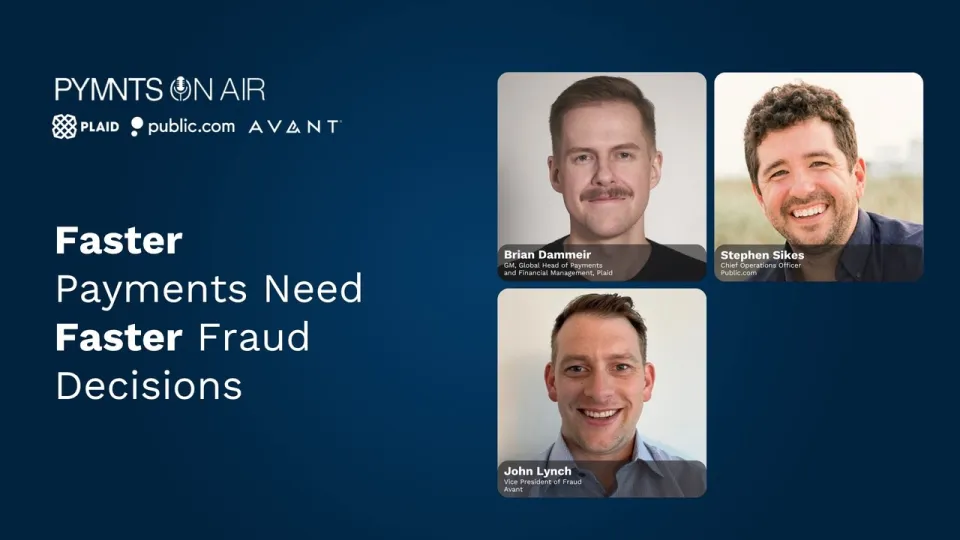
Real-time payments compress the fraud window from T+2 to minutes, and three risk leaders from Avant, Public.com and Plaid dissected the same problem in a PYMNTS interview: when money outruns detection, risk control must move upstream of settlement.
How do fraudsters exploit the time gap?
John Lynch, VP of fraud at Avant, observes that fraudsters study when lenders send their nightly ACH files and which payments can still be returned — timing unauthorized debits to that window. Stephen Sikes, COO at Public.com, describes a more typical scenario: the brokerage grants buying power before a bank deposit settles, and once money leaves while the original ACH debit is still returnable, the exposure is live. Third-party fraud — misusing someone else's account or identity — bets that the issuer restores spending power before the payment bounces, leaving new charges as bad debt.
Why traditional risk control cannot keep up?
Traditional anti-fraud implicitly assumes enough time between transaction and settlement — a T+2 window for interception, returns and manual review. Real-time payments compress that window to near zero: money arrives before the detection verdict. Plaid's perspective adds the other half: fraud signals are scattered across accounts, and any single institution sees only its own segment, not the full money trail.
Three levers for shifting risk left
My judgment: the consensus from this discussion is that risk control must move upstream — supplier verification, account validation, pre-payment controls. PYMNTS Intelligence finds 57% of middle-market firms detect fraud only after settlement. Three concrete levers: pre-payment account and payee verification (KYC/KYB before the transaction), real-time behavioral sequence monitoring (watching for sudden account-activity shifts, not single transactions), and cross-institution signal sharing (the value of data aggregators like Plaid). For risk teams, the conclusion is direct: the KPI must shift from interception rate to pre-settlement prevention rate.
Further Reading
- Today's daily: AI wallets in India, tokenized deposits in Hong Kong, synchronized settlement in London — the deep-analysis companion to today's news
- Agentic commerce B2B payments: who defines AI payment authority — background on the authorization-layer competition
- Compressing settlement from T+3 to T+0: capital pools and FX exposure — the classic tradeoff between settlement speed and FX cost
This article is rewritten from PYMNTS. Original copyright belongs to the author, reproduced here for reference and learning.


