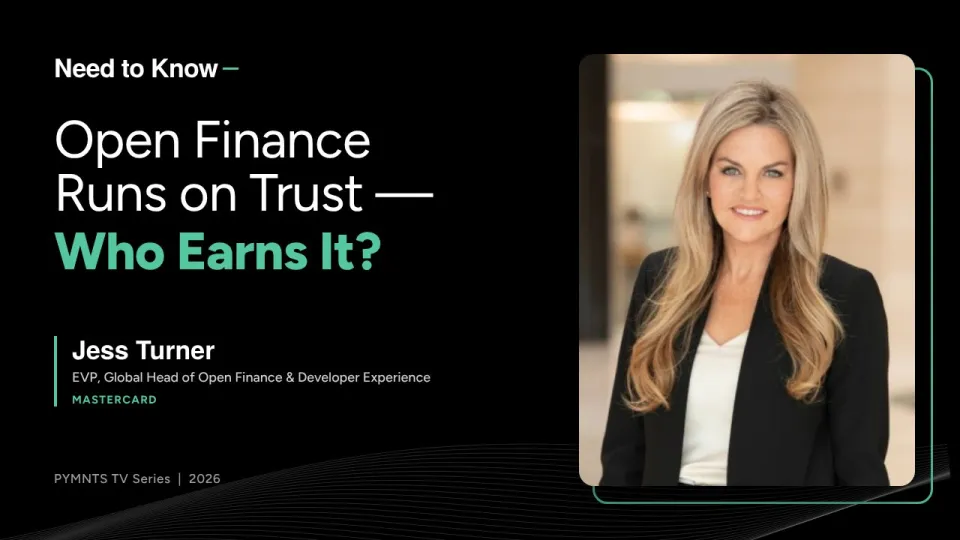
Jess Turner, Mastercard's executive vice president and global head of open finance and developer experience, names the core contradiction of open finance in a PYMNTS interview: services are welcomed, authorizations are hesitated. Consumers like open finance (using their full financial history to secure credit, personalize services, inform payments wherever they choose to do business) yet stall at authorizing connections — unable to tell who will receive their data or what happens afterward.
The scale of the trust gap
Mastercard's own research across 11 markets finds 89% of surveyed consumers concerned about where their data goes. Turner's judgment: trustworthiness is not a one-time act at authorization but something providers must "prove every minute of every day" throughout their dealings with customers. The framing pulls open finance competition back from API and data coverage to trust productization.
My judgment: the next open-finance battle is trust infrastructure
My judgment: the next open-finance battle is not data aggregation capability but trust infrastructure. Whoever lets consumers understand "who, why, how long, and how to revoke" wins authorization rates. Concrete levers: readable disclosure of data purposes (not legal text), granular and revocable authorization (by institution, purpose and time), and data-flow visualization (consumers seeing who accessed their data). Mastercard speaking up at this moment shows it positioning as the trust layer rather than the data layer — consistent with its Agent Pay authorization logic: what card networks bet on is always trusted authorization. For open-banking product teams, the 89% figure deserves a spot on the roadmap wall.
Further Reading
- Today's daily: AI wallets in India, tokenized deposits in Hong Kong, synchronized settlement in London — the deep-analysis companion to today's news
- Agentic commerce B2B payments: who defines AI payment authority — background on the authorization-layer competition
- Compressing settlement from T+3 to T+0: capital pools and FX exposure — the classic tradeoff between settlement speed and FX cost
This article is rewritten from PYMNTS. Original copyright belongs to the author, reproduced here for reference and learning.


