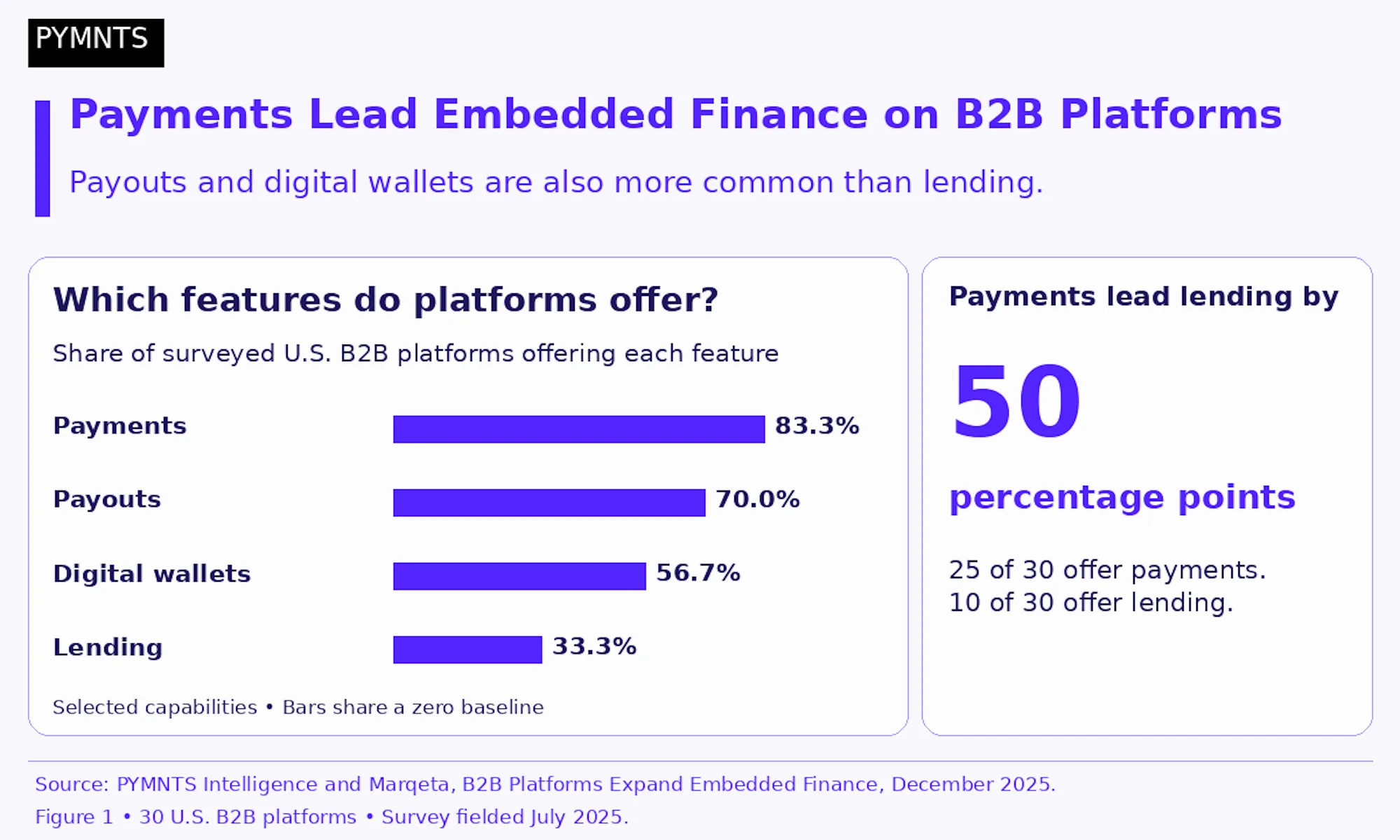
The data in the PYMNTS Intelligence and Marqeta survey is simple enough: of 30 US B2B platforms, 25 offer embedded payments, 21 offer payouts, and only 10 touch lending. Payment embedding adoption runs 2.5 times lending. But the report's real value is that it confirms, with data, a law of sequencing.
Why do payments always come first? Because payments embed into data flows the platform already owns. B2B platforms natively hold the trading relationships — who owes whom, how long the terms are, how reconciliation runs. Embedding payments moves settlement actions that used to happen offline into the platform; the data loop closes naturally, and risk variables stay clean (transaction authenticity is already established). Lending is different: you are underwriting not a transaction but an entity's credit; you bear not a fee but principal risk; and when things go wrong you face not "this entry was booked wrong" but "this money is gone." One game is about integration; the other is about the balance sheet.
So the correct posture for platforms is to follow that sequence: first use payments and payouts to settle the money flow onto the platform (earning data, relationships and frequency), then embed credit in the scenarios where data runs deepest (trading data for risk-pricing capability). Among the 30 respondents, all nine platforms with at least $1 billion in annual revenue offered embedded payments, yet only one-third offered lending — the largest platforms are the most restrained in lending, a contrast that confirms the sequencing logic: the bigger the platform, the clearer it sees where lending's marginal risk lies.
Two data points deserve separate attention from product people. First, 73% of respondents cite a smooth integration process when considering adding or improving payment capabilities — B2B payments has passed the "whether to have it" education phase and entered the "how smooth is it" competition phase. For payment infrastructure vendors, the sales script must shift from "here is what we can do" to "here is how fast you can be live." Second, of the 17 platforms offering digital wallets, 12 are very or extremely interested in upgrading wallet capabilities within two years — the next battle for wallets in B2B is spending controls (real-time limits, purpose restrictions), a signal of the jump from "payment tool" to "treasury management tool."
One closing line for this field's old wisdom: payments are traffic, lending is profit — but reverse the order and you lose both. This survey has quantified that lesson with 30 samples.---
This article is rewritten from PYMNTS. Original copyright belongs to the author, reproduced here for reference and learning.


